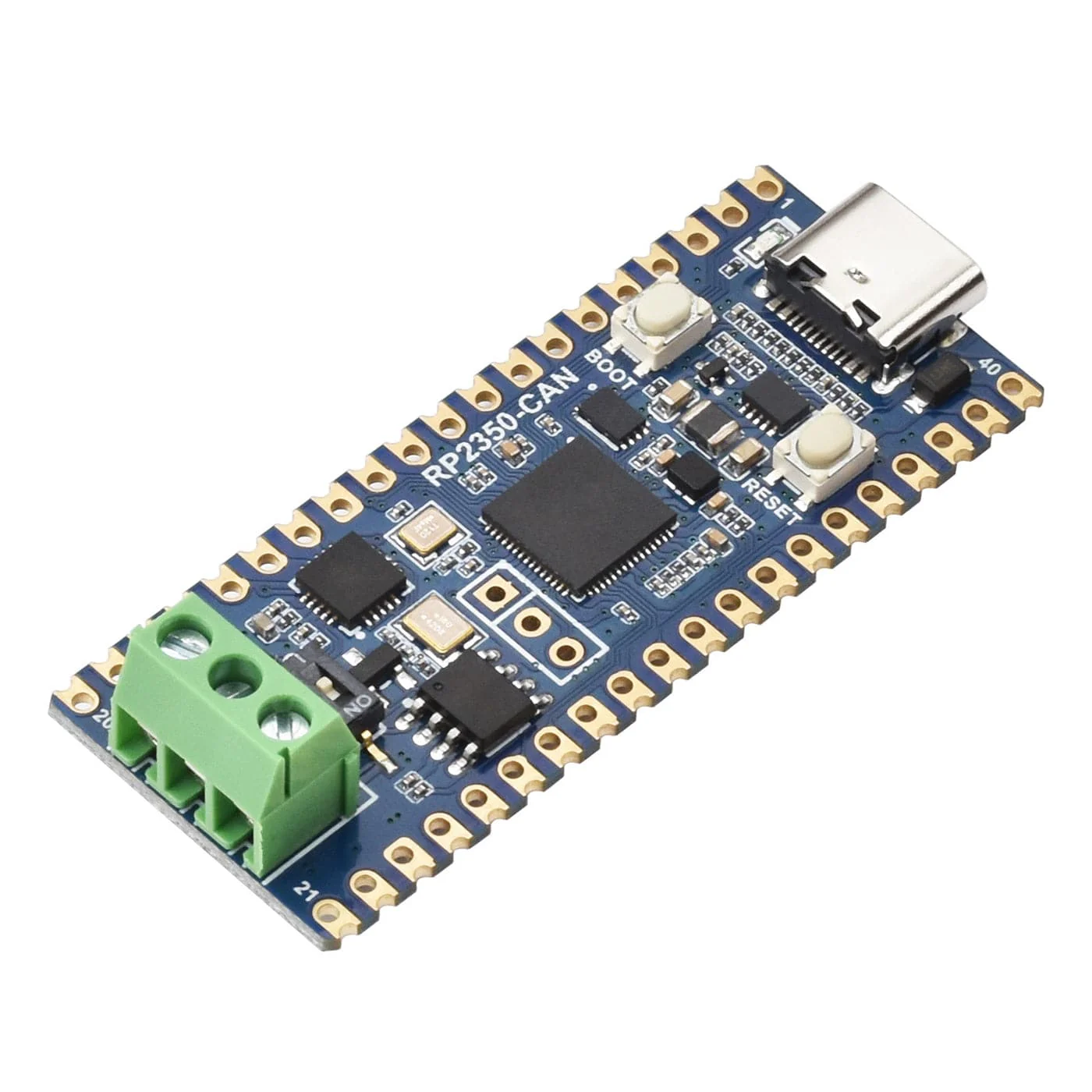
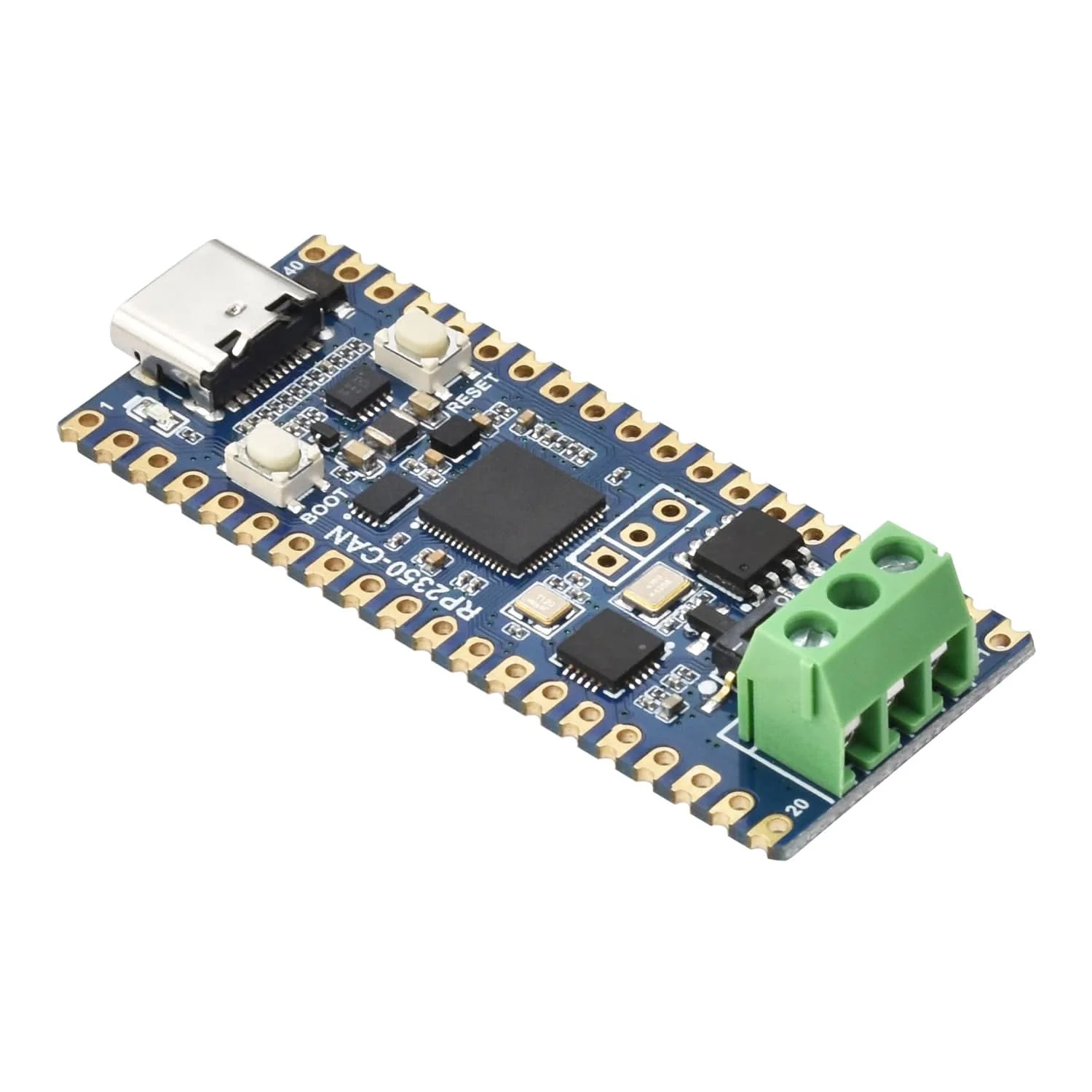
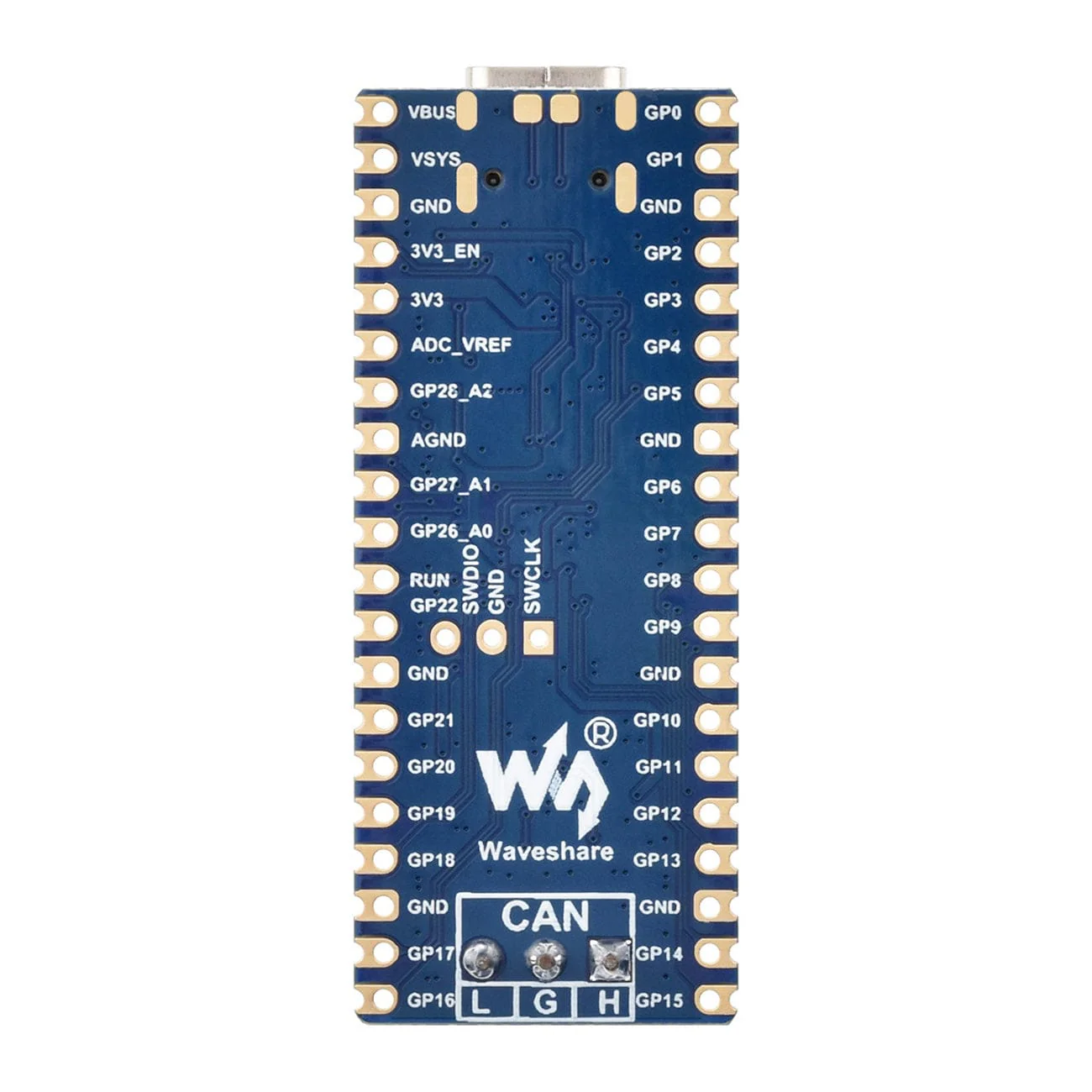
Waveshare RP2350 CAN Development Board
A feature-rich CAN development board featuring a dual-core RP2350A microcontroller and advanced CAN functionality.
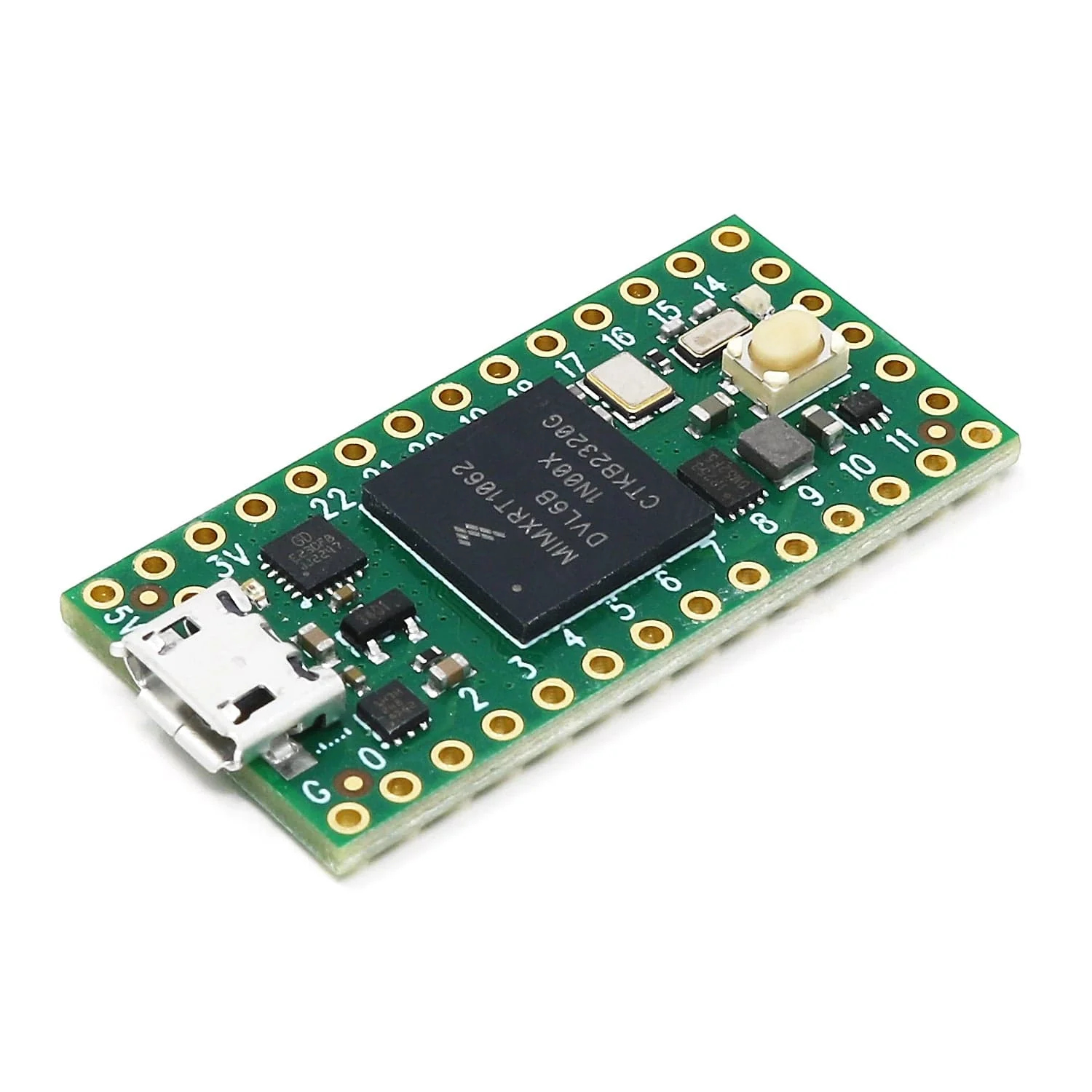
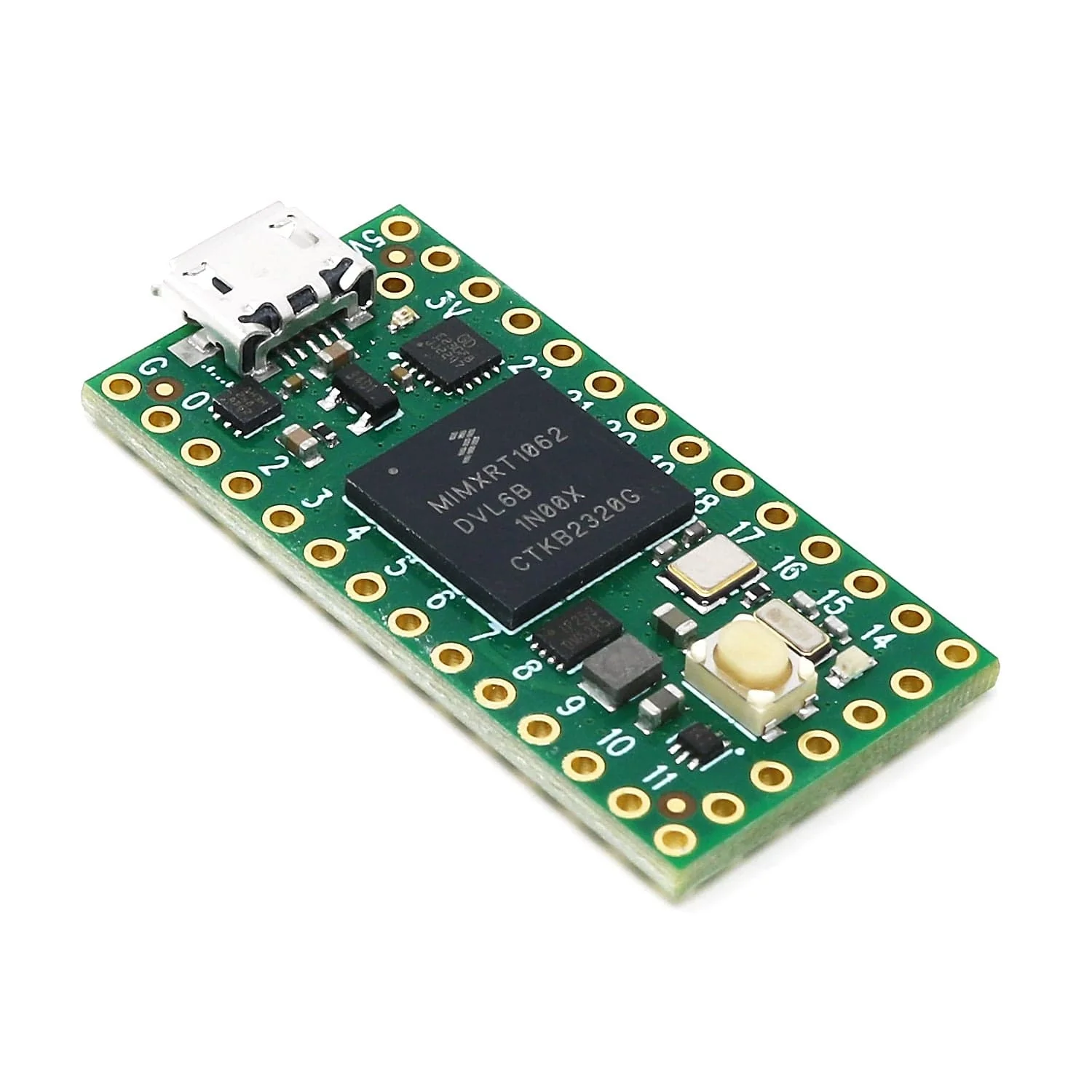
The Waveshare RP2350 CAN Development Board is built around the RP2350A microcontroller, featuring both an ARM Cortex-M33 and Hazard 3 RISC-V processor.
Designed for CAN communication, it includes an XL2515 CAN controller with support for CAN V2.0B at speeds up to 1 Mbps. With 520KB SRAM, 4MB Flash, and a USB Type-C interface, it's easy to integrate and program.
Features
- RP2350A Microcontroller: Dual-core architecture with ARM Cortex-M33 and Hazard 3 RISC-V, running at 150 MHz
- XL2515 CAN Controller: Capable of transmitting and receiving standard, extended, and remote frames at speeds up to 1 Mbps with an onboard SIT65HVD230 transceiver
- Memory & Storage: 520KB SRAM and 4MB Flash to handle complex applications
- USB Type-C Interface: Provides USB 1.1 host and device modes for easy programming and connectivity
- Low-Power Modes: Offers sleep and dormant modes, ideal for battery-powered setups
- Drag-and-Drop Programming: Uses USB mass storage for straightforward firmware updates
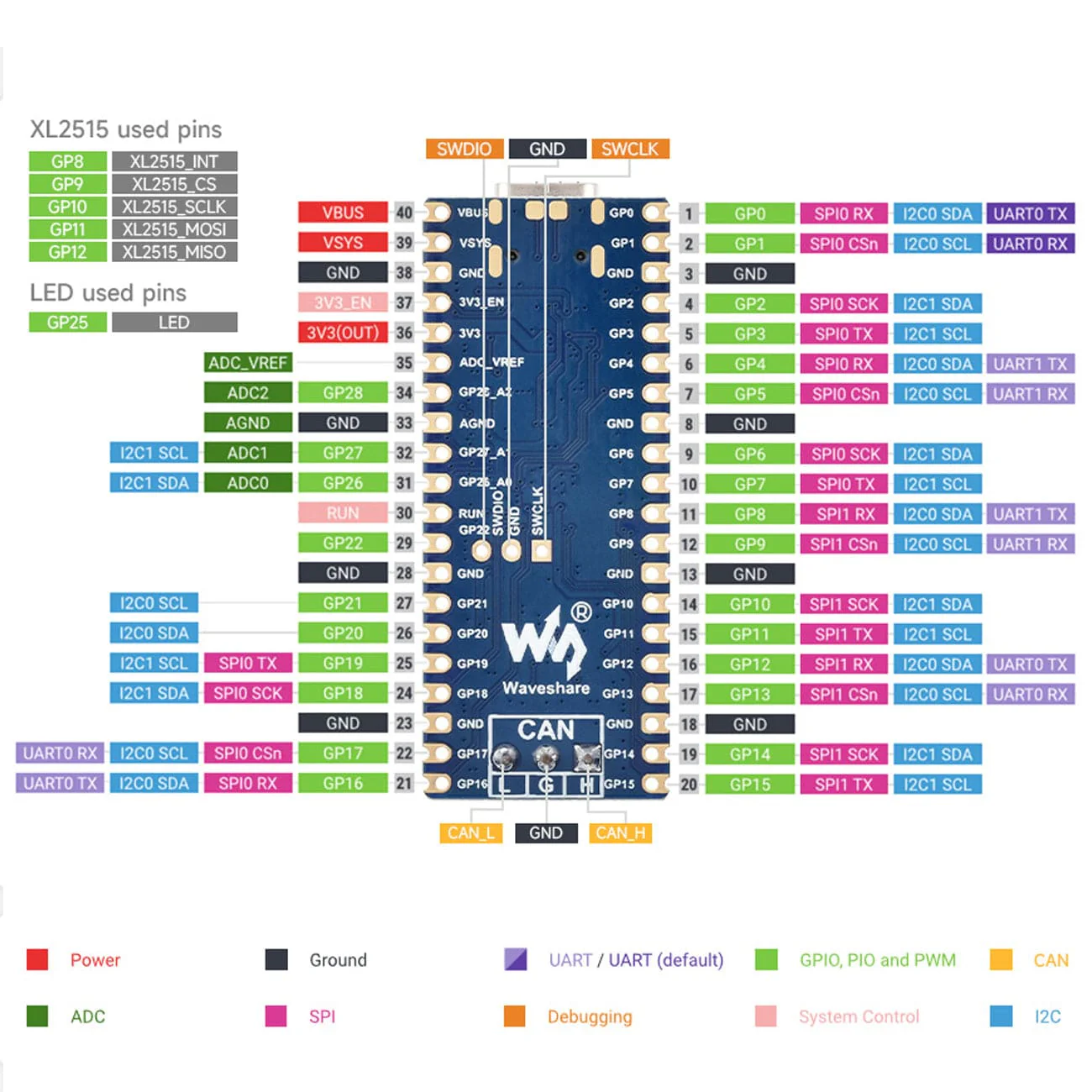
- Flexible I/O Options: 2 × SPI, 2 × I2C, 2 × UART, 4 × 12-bit ADC, 16 × PWM channels, and 26 multi-function GPIO pins
- Additional Capabilities: Built-in temperature sensor, precise clock & timer functions, and 12 programmable PIO state machines
- Compact & Solderable Design: Castellated module enables direct integration onto carrier boards
Specifications
| Microcontroller | RP2350A |
| Processor | ARM Cortex-M33 + Hazard 3 RISC-V |
| Clock Speed | 150 MHz |
| Memory | 520KB SRAM, 4MB Flash |
| CAN Controller | XL2515, CAN V2.0B |
| USB Interface | USB Type-C |
| GPIO Pins | 26 |
| Programming | C/C++, MicroPython |
| Manufacturer’s Product Number | RP2350-CAN |
Onboard Features

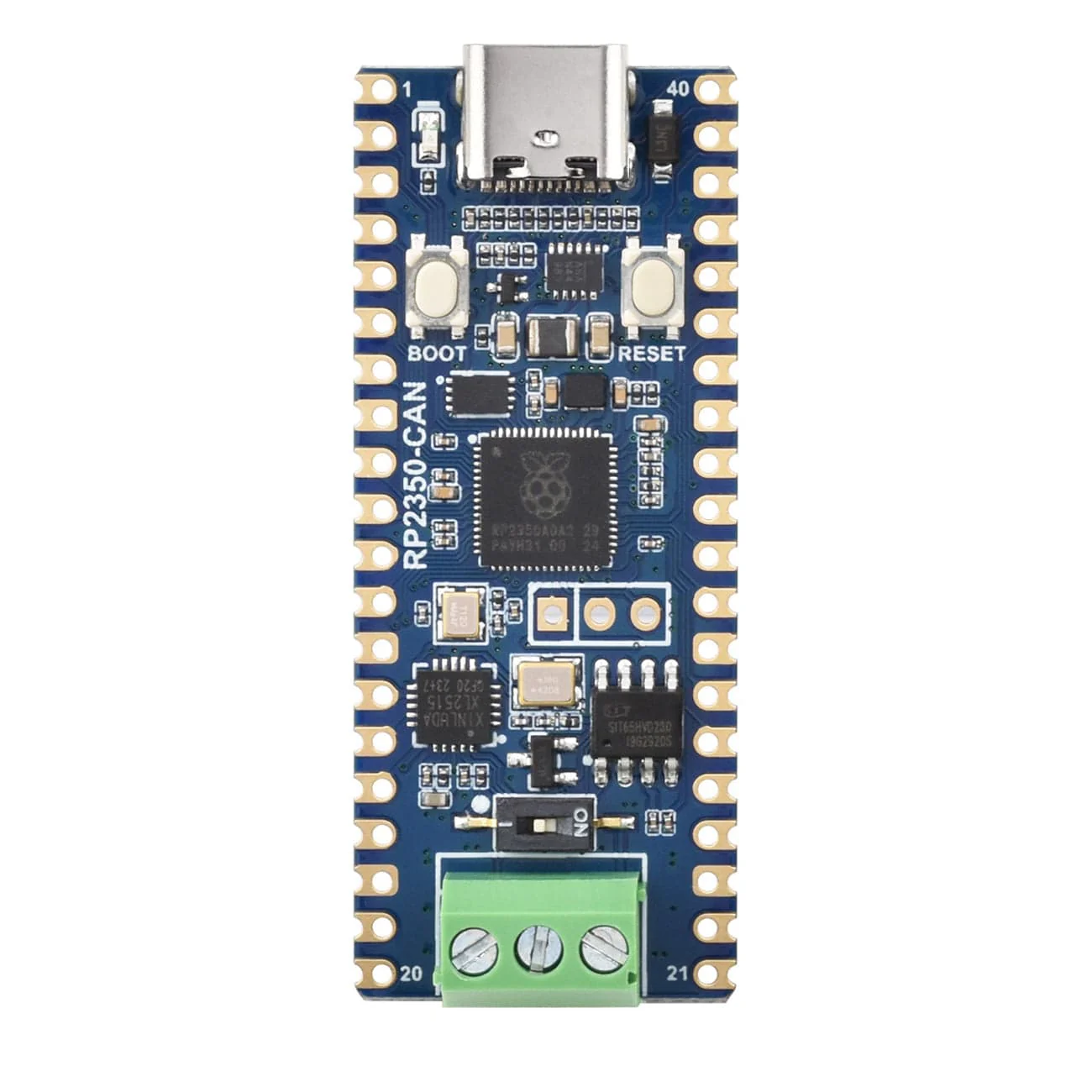
- RP2350A – Dual-core and dual-architecture design, up to 150 MHz operating frequency
- P25Q32SH-UXH-IR – 4MB NOR-Flash
- BOOT Button – Used for entering bootloader mode
- RESET Button – Resets the microcontroller
- MP28164 – High-efficiency DC-DC buck-boost chip
- User LED – Indicator for user-defined functions
- USB Type-C Connector – Used for programming and USB communication
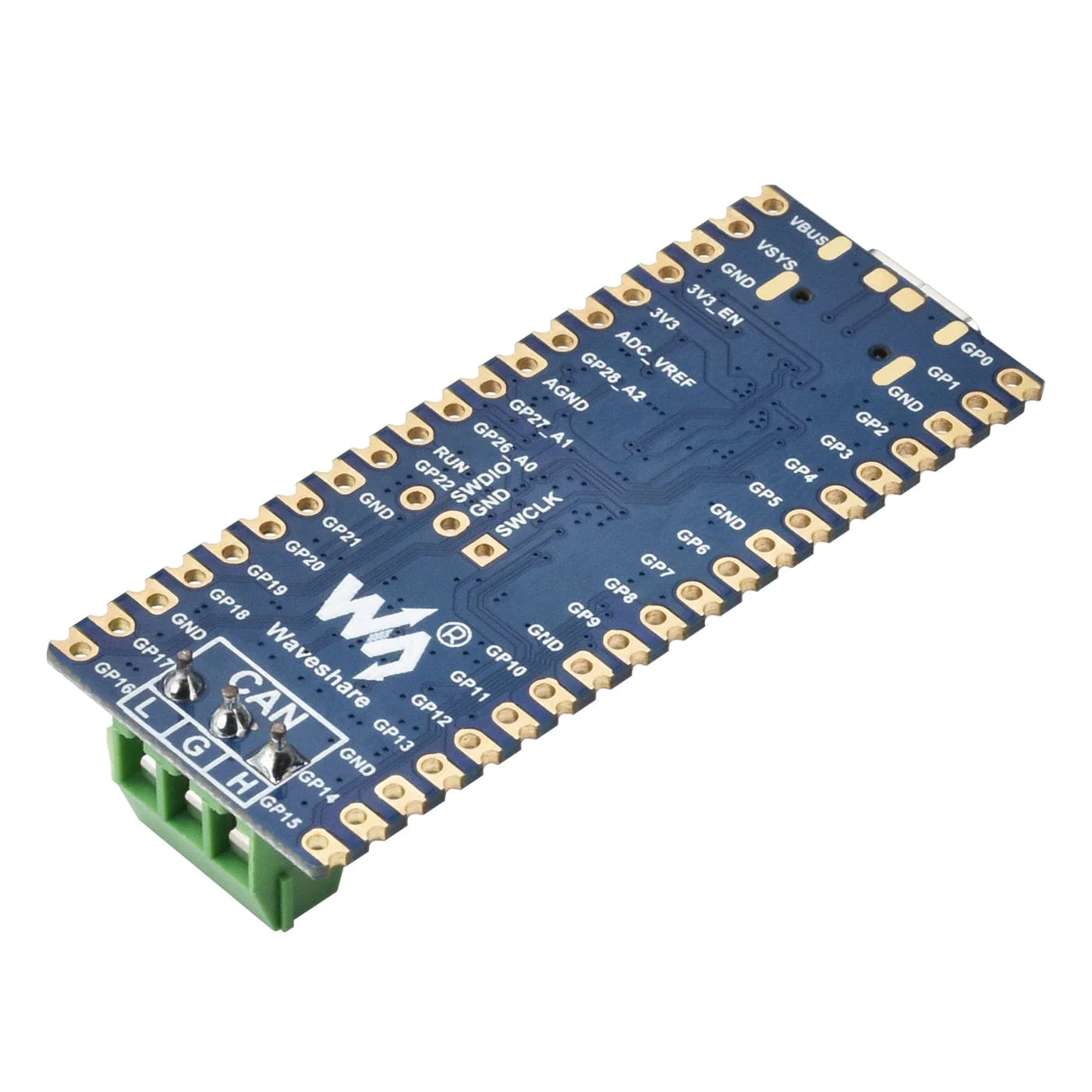
- Debug Pins – For debugging and development
- SIT65HVD230DR – CAN transceiver
- XL2515QF20 – CAN controller
- Terminal Resistor Selection – Enable/disable 120Ω matching resistor
- CAN Screw Terminal – CAN communication interface
- GPIO Header – Compatible with Raspberry Pi Pico pin header
Resources
-
Product Wiki
- Features
- Pinout Definition
- Dimensions
- Getting Started
- Firmware Download
- MicroPython Tutorials
- C/C++ Development
- Arduino IDE Setup
- Open Source Demos
- Documents & Datasheets
- FAQ
Package Contents
- 1x Waveshare RP2350 CAN Development Board
USB-C cable not included
Original: $13.07
-70%$13.07
$3.92Product Information
Product Information
Shipping & Returns
Shipping & Returns
Description
A feature-rich CAN development board featuring a dual-core RP2350A microcontroller and advanced CAN functionality.
The Waveshare RP2350 CAN Development Board is built around the RP2350A microcontroller, featuring both an ARM Cortex-M33 and Hazard 3 RISC-V processor.
Designed for CAN communication, it includes an XL2515 CAN controller with support for CAN V2.0B at speeds up to 1 Mbps. With 520KB SRAM, 4MB Flash, and a USB Type-C interface, it's easy to integrate and program.
Features
- RP2350A Microcontroller: Dual-core architecture with ARM Cortex-M33 and Hazard 3 RISC-V, running at 150 MHz
- XL2515 CAN Controller: Capable of transmitting and receiving standard, extended, and remote frames at speeds up to 1 Mbps with an onboard SIT65HVD230 transceiver
- Memory & Storage: 520KB SRAM and 4MB Flash to handle complex applications
- USB Type-C Interface: Provides USB 1.1 host and device modes for easy programming and connectivity
- Low-Power Modes: Offers sleep and dormant modes, ideal for battery-powered setups
- Drag-and-Drop Programming: Uses USB mass storage for straightforward firmware updates
- Flexible I/O Options: 2 × SPI, 2 × I2C, 2 × UART, 4 × 12-bit ADC, 16 × PWM channels, and 26 multi-function GPIO pins
- Additional Capabilities: Built-in temperature sensor, precise clock & timer functions, and 12 programmable PIO state machines
- Compact & Solderable Design: Castellated module enables direct integration onto carrier boards
Specifications
| Microcontroller | RP2350A |
| Processor | ARM Cortex-M33 + Hazard 3 RISC-V |
| Clock Speed | 150 MHz |
| Memory | 520KB SRAM, 4MB Flash |
| CAN Controller | XL2515, CAN V2.0B |
| USB Interface | USB Type-C |
| GPIO Pins | 26 |
| Programming | C/C++, MicroPython |
| Manufacturer’s Product Number | RP2350-CAN |
Onboard Features
- RP2350A – Dual-core and dual-architecture design, up to 150 MHz operating frequency
- P25Q32SH-UXH-IR – 4MB NOR-Flash
- BOOT Button – Used for entering bootloader mode
- RESET Button – Resets the microcontroller
- MP28164 – High-efficiency DC-DC buck-boost chip
- User LED – Indicator for user-defined functions
- USB Type-C Connector – Used for programming and USB communication
- Debug Pins – For debugging and development
- SIT65HVD230DR – CAN transceiver
- XL2515QF20 – CAN controller
- Terminal Resistor Selection – Enable/disable 120Ω matching resistor
- CAN Screw Terminal – CAN communication interface
- GPIO Header – Compatible with Raspberry Pi Pico pin header
Resources
-
Product Wiki
- Features
- Pinout Definition
- Dimensions
- Getting Started
- Firmware Download
- MicroPython Tutorials
- C/C++ Development
- Arduino IDE Setup
- Open Source Demos
- Documents & Datasheets
- FAQ
Package Contents
- 1x Waveshare RP2350 CAN Development Board
USB-C cable not included